|
Pan American Experiences
|
------- |

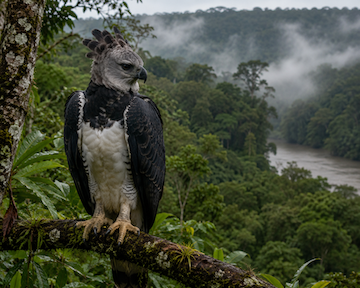
A harpy eagle watches silently above the Amazon Rainforest, where ancient trees still hold the stories, shadows, and silence of the world’s last great wilderness.
Security and Tourism: The Cost of a Tough Approach
|
HEMISPHERE ------------------------------------------1021[TRAVEL+NATURE] | |||
Harpy Eagles: New Findings on One of the Americas’ Greatest PredatorsRecent Research Reveals Local Threats, Gaps in Scientific Knowledge, and New Opportunities to Improve the Conservation of This Tropical Raptor.By Marbel Montoya for Ruta Pantera on 10/18/2026 7:52:13 AM |
||||
| The harpy eagle (Harpia harpyja) is one of the most powerful birds of prey in the Americas. Its massive talons, broad wings, and ability to maneuver through dense forest make it a highly specialized hunter of the tropical canopy. Yet its size and strength offer little protection against threats linked to human activity. Research published in 2026 highlights how local records, community knowledge, and long-term monitoring can help scientists understand what is happening to the species in the forests where it survives.
A Specialist Hunter of the Forest Canopy The harpy eagle inhabits tropical forests from southern Mexico through Central America and much of South America. It hunts primarily in the forest canopy and takes prey such as sloths and arboreal mammals, including monkeys. Its short, broad wings and long tail help it maneuver among trees, where precise control is essential. Females are substantially larger than males, a difference common among many birds of prey. Their legs and talons are adapted to seize prey in the canopy, while their powerful feet help them handle animals that may be surprisingly heavy relative to the eagle’s own size. Harpy eagles reproduce slowly. Pairs depend on large trees suitable for nesting, and the interval between successful breeding attempts can be long. Adults may invest considerable time in raising a chick, meaning the loss of a breeding bird or nest can have consequences beyond a single season. Protecting nesting trees and maintaining connected forest habitat are therefore important parts of conserving the species. What New Research Revealed in 2026 A study published in May 2026 in Ecology and Evolution examined records of harpy eagles in and around the Tabuleiro Forest in Espírito Santo, Brazil. The researchers brought together information collected over approximately five decades, including observations from researchers, reserve personnel, birdwatchers, and local residents. Within the study’s core area, the researchers compiled 88 records: 44 involving adults, eight involving pairs, eight involving juveniles, 19 in which age was unknown, and nine involving nests. The broader surrounding area contributed at least 73 additional historical and recent records. These figures help establish where the species has been observed and where breeding activity has been documented. They do not, however, provide a direct population estimate. An increase in sightings can reflect more people searching, better reporting, or improved access to information rather than an actual rise in the number of eagles. The study also documented direct human-related mortality. Records included an adult and a juvenile that had been shot, two juveniles killed by electrocution, and an adult killed in a road collision. These cases show how the survival of a large forest raptor can depend on conditions beyond the boundaries of a protected area. Brazil’s national assessment of threatened species also changed in 2026, with the harpy eagle removed from the country’s national list. That decision reflects a national assessment and should not be interpreted as proof that the species is secure throughout its range. A country-level classification and a global conservation assessment answer different questions, and local populations may continue to face serious risks. |
||||
|
Why Local Knowledge Matters
Harpy eagles are difficult to monitor across vast, densely forested regions. They occur at low densities, occupy large territories, and can remain undetected even where suitable habitat persists. Scientific surveys alone may therefore miss important information about nesting sites, movements, deaths, and changes in local presence. People who live and work in forest landscapes can help fill those gaps. Their observations, when documented and verified, can direct researchers toward nests, identify threats, and provide historical context that short-term surveys cannot capture. Birdwatchers, Indigenous communities, conservation staff, and local researchers can all contribute to a more complete picture of the species. In Ecuador, for example, Waorani community members have participated in efforts to monitor and protect harpy eagles in the Amazon. Such initiatives connect wildlife conservation with local knowledge and the people who experience changes in the forest firsthand. Indigenous perspectives are not uniform across the Americas, but locally led monitoring can make conservation more relevant to the communities involved and improve the information available to scientists. Conservation Beyond Protected Areas Protecting large tracts of forest remains essential, but the evidence points to the need for additional measures. Monitoring known nests over multiple breeding seasons can help establish whether pairs remain in an area and whether reproduction is successful. Recording sightings consistently, including unsuccessful nesting attempts and confirmed deaths, makes it easier to distinguish genuine population trends from changes in observation effort. Reducing electrocution risks where power infrastructure crosses important habitat, improving road safety in areas used by wildlife, and preventing the shooting of eagles can also address specific causes of mortality. These actions work best when supported by reliable local reporting and coordination among conservation authorities, landowners, researchers, and communities. The harpy eagle’s future cannot be measured by a single national listing or a growing number of sightings. Its conservation depends on sustained evidence: where the birds live, whether they reproduce successfully, what kills them, and whether those pressures are changing. By combining scientific research with long-term local observation, conservationists can make better-informed decisions about one of the most remarkable predators of the American tropics. |
||||
 Add this article to your favorites
[FOR MEMBERS ONLY]
Add this article to your favorites
[FOR MEMBERS ONLY]
Copy this link to send this article to a friend: [FOR MEMBERS ONLY] |
||||

|
|
||||
|---|---|---|---|---|
| |
|
|
|
|
×
|
||||
|
References: Fabres, B., et al. (2026). Local Knowledge and Human–Wildlife Conflict in the Conservation of the Harpy Eagle (Harpia harpyja) in Its Main Refuge in the Atlantic Forest. Ecology and Evolution, 16(5), e73499. https://doi.org/10.1002/ece3.73499 BirdLife International. Harpy Eagle (Harpia harpyja) Species Factsheet. https://datazone.birdlife.org/species/factsheet/harpy-eagle-harpia-harpyja ICMBio. Brazilian Fauna and Threatened Species Information. https://www.gov.br/icmbio/pt-br/assuntos/biodiversidade/fauna-brasileira/fauna-brasileira El País. (2024, August 24). Los Waorani se convierten en águilas para proteger la Amazonía ecuatoriana. https://elpais.com/america-futura/2024-08-24/los-waorani-se-convierten-en-aguilas-para-proteger-la-amazonia-ecuatoriana.html El País. (2026, August 16). Entra el guacamayo azul, sale el águila harpía: así se hace la lista de especies en peligro en Brasil. https://elpais.com/america-futura/2026-08-16/entra-el-guacamayo-azul-sale-el-aguila-harpia-asi-se-hace-la-lista-de-especies-en-peligro-en-brasil-el-pais-con-mas-biodiversidad-del-mundo.html |
||||
Please leave a comment about this article: 1021 |
|
| Enter your email address: |
Your email will not be displayed. |
| Your nickname: | |
| Your comment: | |
| Was this article helpful to you? | |
|
|
|
Articles about exciting travel experiences in our hemisphere.


Cape Froward, Chile




Welcome to the World’s Largest New Year’s Celebration
For those traveling from North, Central, or South America, New Year's Eve in Rio offers a rich narrative about how a city can transform a universal holiday into a unique celebration, rooted in local traditions and open to the world.





















|
Experiences Finder
(Search our catalog of Experiences here.) |
|---|