|
Pan American Experiences
|
------- |

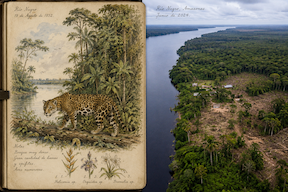
A nineteenth-century naturalist’s sketch and a modern aerial view of the Amazon reveal the same landscape through two very different lenses — one documenting discovery, the other recording transformation.
Urban Bats: The Wildlife Flying Above Latin American Cities |
HEMISPHERE ------------------------------------------1004[TRAVEL+NATURE] | |||
The Naturalist’s Notebooks: What 19th-Century Illustrations Reveal About a Changing AmazonHistorical Drawings Offer Clues to Amazonian Biodiversity and Reveal How Naturalists Portrayed the Rainforest More Than a Century Ago.By Marbel Montoya for Ruta Pantera on 10/19/2026 11:23:18 AM |
||||
| During the 19th century, long before photography could easily document tropical environments, naturalists relied on field notebooks, watercolors, engravings, and illustrated plates to record their observations of the Amazon. Their pages depicted animals, plants, rivers, and landscapes that circulated through museums, libraries, and scientific publications across Europe and North America. Today, these materials form a valuable historical archive, although they must be interpreted carefully. They are not exact photographs of the forest but representations shaped by observation, specimens, written notes, and artistic decisions. Scientific illustration served an essential purpose. It allowed researchers to describe species, compare their characteristics, and share discoveries with colleagues who might never visit the region. A plant collected along a riverbank could later appear in a published illustration; a bird observed during an expedition could be rendered with detailed plumage, bill shape, and body proportions. Each drawing contributed to a growing body of knowledge about a region whose biological diversity presented extraordinary challenges to science at the time. |
||||
|
A Rainforest Seen Through Drawings Among the naturalists associated with scientific exploration in South America were Alexander von Humboldt, Henry Walter Bates, and Alfred Russel Wallace. Their journeys and research differed, but their observations helped expand European understanding of tropical ecosystems. Humboldt traveled through parts of South America in the early 19th century. Bates spent 11 years in the Brazilian Amazon, from 1848 to 1859, studying its wildlife. Wallace also conducted research on species distribution during his travels through the Amazon Basin. Their writings, observations, and the visual materials produced during this period reveal the effort required to describe a natural world that could not be understood through a handful of isolated specimens. The rainforest contained countless forms of life, and understanding it required documenting differences between species, studying their habitats, and observing relationships between organisms and their surroundings. Historical illustrations reveal a recurring feature of many portrayals of the Amazon: the emphasis on abundant vegetation, towering trees, densely covered riverbanks, and a remarkable variety of birds and mammals. Yet an illustration centered on a jaguar, a macaw, or an unusual plant does not necessarily indicate how common that species was or represent the full composition of its habitat. Illustrators selected subjects according to scientific interest, visual appeal, and the objectives of the publication. These documents should therefore be read as partial records. They can provide information about the appearance of particular organisms and the knowledge available to observers at the time, but they cannot independently reconstruct the ecological condition of a location. Establishing environmental change requires comparison with expedition diaries, identified locations, museum collections, ecological studies, and other historical evidence. What the Illustrations Show—and What They Leave Out Historical illustrations also reflect the prevailing ideas about nature during the 19th century. In many publications, the Amazon appears as an immense expanse of vegetation populated by extraordinary animals and seemingly endless forest. This image partly reflected travelers' amazement at an environment unlike those in their homelands, as well as publishers' interest in presenting unfamiliar landscapes and species to their readers. But the history of the Amazon has never been exclusively a story of wilderness. Indigenous peoples have inhabited, used, and shaped different landscapes across the basin for thousands of years. Their knowledge of plants, animals, soils, and river cycles has been fundamental to life in the region. Yet publications of the period did not always give Indigenous communities appropriate recognition. Some representations relegated local societies to the background while emphasizing the supposed untouched character of the forest. That omission matters when historical illustrations are used as evidence. The absence of roads, settlements, or cultivated areas in a drawing does not prove that a territory was uninhabited or unaffected by human activity. The framing, purpose, and artistic conventions of an illustration could leave essential elements of the landscape out of view. Differences between historical records and contemporary images can raise important questions about environmental transformation, provided that equivalent locations and features are compared. Across parts of the Amazon Basin, agricultural expansion, road construction, mining, and other activities have caused forest loss and fragmentation. At the same time, extensive areas retain remarkable biological diversity, and many Indigenous territories continue to play an important role in forest conservation. Nineteenth-century notebooks cannot, on their own, measure how much forest has disappeared since that period. Their value lies in providing historical evidence that can be combined with maps, photographs, satellite imagery, and scientific studies to investigate changes in vegetation, land use, and perceptions of the natural world. These notebooks also reveal something about scientific practice itself: careful observation took time. Naturalists recorded physical features, noted behavior, compared specimens, and documented the conditions in which they encountered plants and animals. Although their methods and conclusions had limitations typical of their era, their notebooks preserve details that remain useful to researchers and historians. Today, these pages offer a way to explore two interconnected histories: that of one of the planet's most biologically diverse regions and that of the people who sought to understand it through drawing and writing. They do not provide a complete picture of the Amazon in the past, but they help researchers ask more precise questions about what changed, what remains, and what early observers failed to record. The Amazon depicted in these illustrations belongs to a different era, but it is more than a memory of a lost rainforest. It is a historical resource that, interpreted alongside contemporary science and the knowledge of the region's inhabitants, can deepen our understanding of the forest and the responsibility to conserve it. |
||||
 Add this article to your favorites
[FOR MEMBERS ONLY]
Add this article to your favorites
[FOR MEMBERS ONLY]
Copy this link to send this article to a friend: [FOR MEMBERS ONLY] |
||||
|
|
||||
|---|---|---|---|---|
| |
|
|
|
|
×
|
||||
|
References: Bates, H. W. (1863). The Naturalist on the River Amazons. https://www.gutenberg.org/ebooks/2440 Encyclopaedia Britannica. Henry Walter Bates. https://www.britannica.com/biography/Henry-Walter-Bates Biodiversity Heritage Library. Historical collections of biodiversity literature and illustrations. https://www.biodiversitylibrary.org/ World Wildlife Fund (WWF). Amazon. https://www.worldwildlife.org/places/amazon |
||||
Please leave a comment about this article: 1004 |
|
| Enter your email address: |
Your email will not be displayed. |
| Your nickname: | |
| Your comment: | |
| Was this article helpful to you? | |
|
|
|
Articles about exciting travel experiences in our hemisphere.
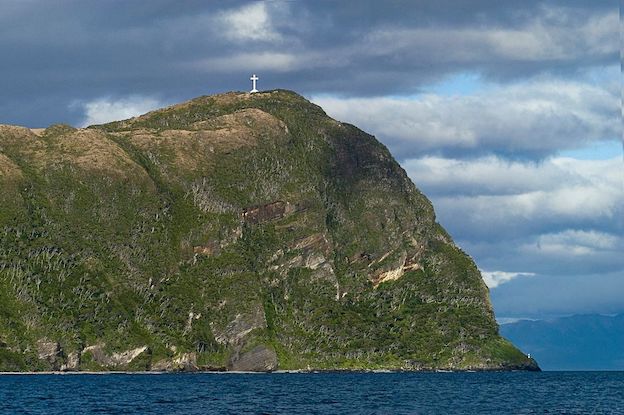
Cape Froward, Chile
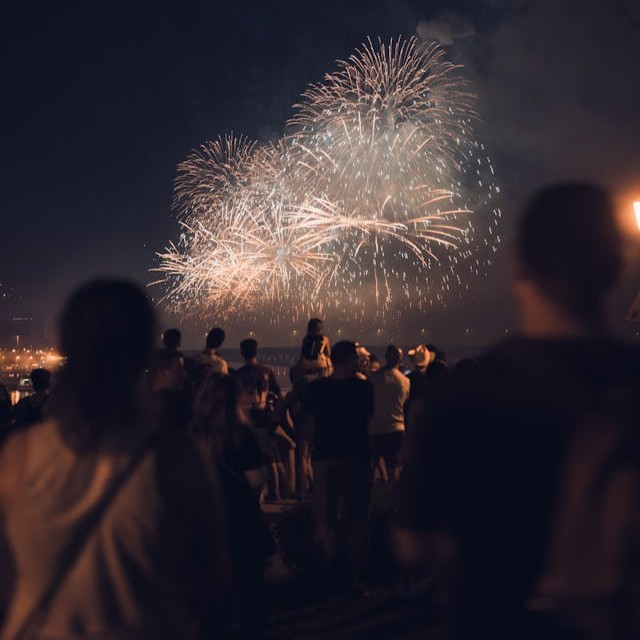

Welcome to the World’s Largest New Year’s Celebration
For those traveling from North, Central, or South America, New Year's Eve in Rio offers a rich narrative about how a city can transform a universal holiday into a unique celebration, rooted in local traditions and open to the world.









|
Experiences Finder
(Search our catalog of Experiences here.) |
|---|