|
Pan American Experiences
|
------- |

Mexico |
MEXICO ------------------------------------------831[FEATURE] BREAK FOR BLESSING | |||
The Original Piñata: The Clay Legacy That Survived the CenturiesA Mexican Tradition that Fuses Ancient Cultures and Resists ModernityBy Jazmin Agudelo for Ruta Pantera on 1/6/2026 10:16:57 AM |
||||
| At the heart of Mexico’s Christmas posadas beats an object filled with history and symbolism: the traditional clay piñata. Although today cardboard versions shaped like cartoon characters abound, the original piñata — made from a clay pot decorated with spikes and colorful paper — represents a cultural legacy that has transcended centuries. This craft not only evokes joy and togetherness, but also embodies a unique fusion of pre-Hispanic, European, and Asian traditions, adapted by evangelizers to teach Christian values in colonial Mexico.
From China to Italy to Spain The origins of the piñata go back to ancient China, where during New Year celebrations, figures of animals such as oxen or cows—made of clay or paper and filled with seeds—were broken. According to historical accounts, Marco Polo observed this custom in the 13th century and brought it to Europe, where in Italy it became known as pignatta, meaning a fragile pot. In Spain, it was adapted for Lenten festivities using clay pots decorated with ribbons and paper. However, similar practices already existed in Mesoamerica: the Aztecs broke clay vessels adorned with feathers in honor of Huitzilopochtli, and the Maya played games involving breaking pots filled with cacao while blindfolded. When the Augustinian friars arrived in New Spain in the 16th century, they found in these similarities an opportunity for evangelization. In the Acolman convent in the State of Mexico, around 1586, Fray Diego de Soria obtained papal permission to celebrate the misas de aguinaldo — precursors to the posadas — and incorporated the piñata as a teaching tool. The clay pot was covered with brightly colored paper representing worldly temptations, and seven spikes or cones were added, symbolizing the seven deadly sins: pride, greed, lust, wrath, gluttony, envy, and sloth. |
||||
|
The act of breaking the piñata acquired deep religious meaning. The blindfold represents blind faith; the stick symbolizes virtue and divine strength that destroys evil; and the candies or fruits that fall when it breaks evoke heavenly graces and blessings. Traditionally filled with seasonal fruits such as tejocotes, sugar cane, tangerines, jícamas, and peanuts, the piñata rewarded perseverance and reminded participants that with faith, sin can be overcome. This allegory became perfectly integrated into the posadas, which reenact Mary and Joseph's pilgrimage, strengthening catechesis among Indigenous communities.
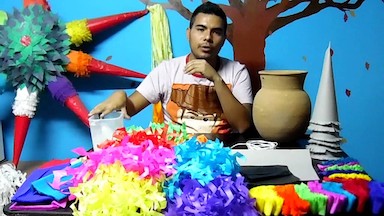
In Acolman, considered the birthplace of the Mexican piñata, artisans preserve this ancestral tradition. Entire families — many led by women — create piñatas using clay pots as a base, covered with layers of newspaper and paste, and adorned with tissue or crepe paper in vibrant colors. The process is laborious: shaping the structure, attaching cardboard spikes, and decorating with fringes and details that evoke stars or traditional forms. Although the clay ensures authenticity and a characteristic sound when broken, its use has diminished due to injury risks, giving way to safer and more versatile cardboard. Melding the Past with the Present The evolution of the piñata reflects social and practical changes. From rigid and dangerous clay, it transitioned to cardboard and papier-mâché, allowing for complex shapes such as movie characters or animals. This shift, accelerated in the 20th century, prioritized child safety and commercialization but diluted the original symbolism. Modern piñatas, filled with industrial candies, are used at birthdays and various events, expanding their global reach but losing the connection to seasonal fruits and the Christmas ritual. Despite modernization, the legacy of the clay piñata persists in communities like Acolman, where the International Piñata Fair attracts visitors every December. Artisans strive to preserve the traditional technique, facing challenges such as the shortage of clay pots and competition from mass production. This cultural resistance highlights the importance of preserving ancestral crafts in a world dominated by the ephemeral. Today, breaking a piñata transcends religious meaning: it brings families together, encourages community bonding, and evokes nostalgia. In a multicultural Mexico, this object symbolizes resilience and syncretism, reminding us that traditions evolve without losing their essence. The original clay piñata, with its fragility and beauty, invites us to value the past as we celebrate the present. |
||||
|
|
||||
|---|---|---|---|---|
| |
|
|
|
|
×
|
||||
|
References: Artesanías Flor de Piña. (2023). La piñata en México: historia, origen, de qué se rellena y significado. https://www.flordepina.mx/blogs/blog-de-artesanias/la-pinata-en-mexico-historia-origen-de-que-se-rellena-y-significado Casa de México. (2022). Origen de la piñata. https://www.casademexico.es/noticia/origen-de-la-pinatas/ Chilango. (2024). Piñatas navideñas de Acolman: tradición artesanal de 500 años. https://www.chilango.com/noticias/ve-por-pinatas-navidenas-al-lugar-donde-se-inventaron-conoce-acolman-y-a-sus-artesanos/ México Desconocido. (2019). El significado de las piñatas. https://www.mexicodesconocido.com.mx/significado-las-pinatas.html Superprof. (n.d.). Historia de la piñata. https://www.superprof.mx/blog/historia-de-las-pinatas-mexico/ |
||||
Please leave a comment about this article: 831 |
|
| Enter your email address: |
Your email will not be displayed. |
| Your nickname: | |
| Your comment: | |
| Was this article helpful to you? | |
|
|
|
Articles about exciting travel experiences in our hemisphere.

ADVENTURE
Cape Froward, Chile

BEACH & SUN

Welcome to the World’s Largest New Year’s Celebration
For those traveling from North, Central, or South America, New Year's Eve in Rio offers a rich narrative about how a city can transform a universal holiday into a unique celebration, rooted in local traditions and open to the world.












|
Experiences Finder
(Search our catalog of articles here.) |
|---|