|
Pan American Experiences
|
------- |

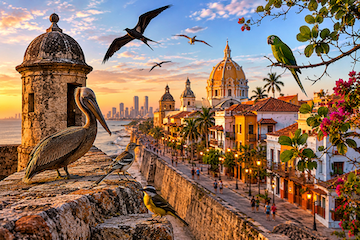
At sunrise, Cartagena’s ancient walls become a perch for pelicans, kiskadees, and frigatebirds — a reminder that one of the Caribbean’s great birdwatching destinations hides in plain sight among the city’s colonial stones.
The Rubber Tree: Indigenous Knowledge, Industrial Dreams, and the Ruins of Fordlandia
|
HEMISPHERE ------------------------------------------1040[TRAVEL+NATURE] | |||
Cartagena’s Urban Birds: From Historic Walls to Caribbean MangrovesDiscover the Coastal Birds, Migratory Species, and Vital Wetlands That Sustain Wildlife in and Around Cartagena.By Marbel Montoya for Ruta Pantera on 10/18/2026 11:36:15 AM |
||||
| Cartagena de Indias is home to a surprising variety of birdlife, from brown pelicans hunting along the Caribbean shoreline to colorful songbirds inhabiting urban parks and migratory species stopping in coastal wetlands. Beyond its celebrated fortifications and colonial architecture, the city occupies a landscape where the Caribbean Sea, tropical dry forest, mangroves, and freshwater environments support a rich diversity of wildlife. A review of the district’s birdlife presented at the Fifth Colombian Ornithology Congress in 2016 documented 296 bird species in Cartagena through a compilation of existing records, including 66 migratory species. This historical inventory covers the wider district rather than the historic center alone, but it illustrates the ecological importance of a region where urban development intersects with several distinct natural habitats. For birdwatchers, this variety creates opportunities to observe wildlife across a relatively compact area. The stone ramparts offer views of coastal birds, parks provide shelter and food for species adapted to urban environments, and the wetlands beyond the city reveal a more complex ecosystem shaped by tides, rainfall, and seasonal movements. |
||||
|
Coastal Birds and Wildlife Among the Mangroves Along Cartagena’s seafront, brown pelicans are among the easiest birds to recognize. They fly low over the water before plunging toward schools of fish, while magnificent frigatebirds use rising air currents to soar with minimal effort. Royal terns and other seabirds may gather along rocky shores and exposed coastal edges, where access to marine food makes these areas important feeding grounds. The bird community changes in parks and tree-lined streets. Great kiskadees announce their presence with loud, distinctive calls, while bananaquits visit flowering plants to feed on nectar. Tanagers, flycatchers, parakeets, and other species use the available vegetation for food, shelter, and nesting. Parque del Centenario, close to the historic center, provides an accessible place to observe urban wildlife among its mature trees and landscaped areas. Sightings vary with the season and local conditions, making patient observation more rewarding than searching for a predetermined list of species. Farther north, the wetlands around La Boquilla and the Ciénaga de la Virgen offer a different perspective on Cartagena’s biodiversity. Mangrove channels, shallow lagoons, and muddy margins support herons, egrets, cormorants, and kingfishers. Depending on water levels and the time of year, migratory birds also use these habitats to rest and feed during their journeys between North and South America. The Ciénaga de la Virgen periodically attracts birds that become particularly conspicuous when they gather in large numbers. In January 2026, Cartagena’s municipal government reported sightings of more than 100 American flamingos in the wetland. Such observations highlight the area’s potential for wildlife watching, although the presence and abundance of individual species can change as environmental conditions shift. Mangroves are essential to this wildlife. Their intricate root systems provide shelter for juvenile fish and crustaceans, support coastal food webs, trap sediments, and help reduce shoreline erosion. Pollution, habitat loss, and changes to natural water flows can weaken these functions, affecting the birds and other animals that depend on healthy wetlands. Migration, Conservation, and Responsible Birdwatching Colombia’s Caribbean region forms part of a broader network of habitats used by birds moving between North and South America. Some species pass through during seasonal migrations, while others remain in the region throughout the year. Cartagena’s coastal wetlands, shorelines, and green spaces contribute to this network, although the species present at any particular site depend on habitat quality, weather, and season. Visitors hoping to identify birds can consult eBird, a platform maintained by the Cornell Lab of Ornithology, to review recent observations and explore species records for specific locations. These records help guide an outing but cannot guarantee sightings. Binoculars and a field guide are useful, and a knowledgeable local guide can help visitors distinguish similar species and understand the ecological relationships within mangrove habitats. In La Boquilla, guided canoe trips through designated mangrove channels offer an opportunity to observe wetland wildlife while learning about the relationship between local communities, fishing, and coastal ecosystems. Choosing responsible operators is important: visitors should maintain a respectful distance from birds, avoid disturbing nesting areas, never feed wildlife, and follow local guidance about where to navigate. The best birdwatching experience is not necessarily the one with the longest species list. Learning why a pelican hunts close to shore, how a mangrove provides shelter for aquatic life, or why a migratory bird pauses in a Colombian wetland offers a deeper understanding of the landscape. Cartagena’s birdlife reveals an ecological dimension of the city that is easy to overlook but fundamental to its identity as a Caribbean destination. Protecting these habitats is essential to preserving that diversity. As urban development and tourism continue to shape the coastline, the condition of the surrounding wetlands and green spaces will influence whether wildlife can continue to thrive alongside the city. For nature-minded travelers, observing Cartagena’s birds offers both a rewarding encounter with biodiversity and a closer look at the ecosystems that sustain it. |
||||
 Add this article to your favorites
[FOR MEMBERS ONLY] Copy this link to send this article to a friend: [FOR MEMBERS ONLY] |
||||

|
|
||||
|---|---|---|---|---|
| |
|
|
|
|
×
|
||||
Please leave a comment about this article: 1040 |
|
| Enter your email address: |
Your email will not be displayed. |
| Your nickname: | |
| Your comment: | |
| Was this article helpful to you? | |
|
|
|
Articles about exciting travel experiences in our hemisphere.

Cape Froward, Chile



Welcome to the World’s Largest New Year’s Celebration
For those traveling from North, Central, or South America, New Year's Eve in Rio offers a rich narrative about how a city can transform a universal holiday into a unique celebration, rooted in local traditions and open to the world.














|
Experiences Finder
(Search our catalog of Experiences here.) |
|---|