|
Pan American Experiences
|
------- |

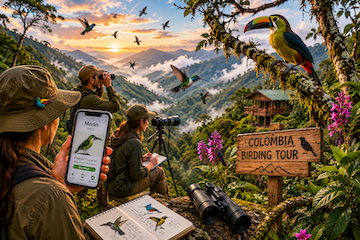
Birdwatchers scan the mist-covered forests of Colombia, where birdsong, technology, and local communities are helping redraw the country’s tourism map one species at a time.
Six Places in the Americas Where You Can Still Hear Real Silence
|
HEMISPHERE ------------------------------------------1024[TRAVEL+NATURE] | |||
The Birds You Can Find With Your PhoneHow Technology Is Changing Birdwatching in ColombiaBy Marbel Montoya for Ruta Pantera on 10/8/2026 7:52:13 AM |
||||
| The sound arrived before the bird did. Somewhere inside the mist of the Andean forest, a string of liquid notes drifted through moss-covered trees. The guide immediately raised his hand and everyone stopped walking. Nobody spoke. In the humid mountains above Valle del Cauca, silence is part of birdwatching. First you listen. Then you search. Then it appeared. A flash of yellow and black crossed briefly between branches heavy with bromeliads before disappearing again. The guide smiled softly. “Toucan barbet,” he whispered, as if saying it too loudly might break something invisible inside the forest. Around us, several people slowly lifted their phones before even reaching for their binoculars. Not to take photographs. To open an app. In Colombia, birdwatching no longer happens only through notebooks and expensive cameras. It now happens through glowing screens in the middle of the rainforest, through apps capable of recognizing hidden songs, and through digital maps guiding travelers toward villages where the forest still stands intact. Tools like Merlin Bird ID and eBird have transformed the way thousands of people travel through the country. And few places in the world had as much to gain from that transformation as Colombia. With nearly 2,000 recorded species, Colombia holds more bird species than any other country on Earth. From tiny hummingbirds in the páramos to scarlet macaws crossing Amazonian skies, the country functions like a massive biological corridor connecting mountains, rainforests, coastlines, and tropical rivers. But for decades, many of those regions remained absent from the international tourism map. Armed conflict, rural isolation, and lack of infrastructure kept some of the most biodiverse places in the continent largely inaccessible to foreign travelers. After the 2016 peace agreement, certain regions slowly reopened. Alongside them came a different kind of visitor: people traveling thousands of miles simply to hear a bird sing through mountain fog. Today, in small towns across the Andes and Colombia’s Pacific region, entire families partly depend on birdwatching tourism. What a Birdwatching Tour in Colombia Actually Looks Like Most tours begin before sunrise. At four or five in the morning, vehicles head toward private reserves, cloud forest trails, or rural fincas adapted to receive birders. The goal is not simply to see birds. It is to find them during the exact moment the forest wakes up. Near places like Tatamá National Natural Park, the air itself seems alive with invisible wings. Emerald toucans, multicolored tanagers, iridescent hummingbirds, and endemic species appear for only seconds before vanishing into layers of wet vegetation. Some visitors spend hours waiting for a single sighting. And this is where the apps have changed everything. How to Use Merlin Bird ID in Colombia Merlin Bird ID works like an AI-powered field assistant. The app can identify birds through photographs, descriptions, or live audio recordings captured directly in the forest. It is powered by millions of observations collected through eBird. In Colombia, where many birds remain hidden deep inside the canopy, the sound-recognition feature has become especially important. Sometimes travelers never clearly see the bird at all. They only hear distant notes while the app analyzes the sound in real time. Guides usually recommend downloading offline regional bird packs before entering remote areas without signal. Many also suggest using external microphones or headphones to better isolate bird calls inside humid forests. Among beginner birders, there is almost a shared ritual: the moment Merlin correctly identifies the first rare species heard somewhere deep in the mountains. How to Use eBird to Plan Birding Routes While Merlin helps identify birds, eBird functions as a living global map of birdwatching. The platform allows travelers to explore hotspots, log sightings, and follow routes where other birders have recently recorded specific species. Many travelers now organize entire itineraries through Colombia using eBird hotspots: The cloud forests of Minca for endemic species of the Sierra Nevada. Reserves in Valle del Cauca known for tanagers and Andean toucans. Rainforests around Leticia for macaws, antbirds, and Amazonian species. The plains of Meta and Los Llanos for raptors and savanna birds. The Chocó biogeographic region near Nuquí, where some birds exist nowhere else on Earth. |
||||
|
The platform also helps travelers understand which species are most likely depending on season, altitude, and exact location. The Local Companies Now Living From Birdsong In many parts of Colombia, birding tours are led by people who grew up hearing birds long before they learned their scientific names. Some were farmers. Others were fishermen. Some spent decades living in territories shaped by armed conflict. Today they work as trackers, drivers, cooks, and specialized birding guides. Small lodges and local tour companies have begun transforming rural homes into destinations for birdwatchers. In western Colombia, entire families maintain gardens specifically designed to attract hummingbirds and tanagers through native flowers and fruiting trees. Bird tourism works differently from mass tourism. Groups are usually small. Silence matters. The forest must remain intact for the experience to exist. As one Colombian tour operator recently explained in an interview: if the forest disappears, the business disappears with it. Colombia’s New Invisible Map Something unusual is happening across the country. For decades, many foreigners associated Colombia primarily with stories of violence and narcotrafficking. Now some travelers arrive carrying species checklists and directional microphones, searching for birds found only within isolated fragments of rainforest. And in places where the jungle was once viewed mainly as an obstacle to economic development, it is beginning to acquire a different kind of value. Every toucan photographed, every hummingbird uploaded into eBird, every traveler paying to walk quietly through the forest becomes another reason to keep trees standing. In certain Colombian mornings, it is still possible to hear one of the richest ecosystems on Earth waking up. It does not begin with engines. It begins with birds. |
||||
 Add this article to your favorites
[FOR MEMBERS ONLY]
Add this article to your favorites
[FOR MEMBERS ONLY]
Copy this link to send this article to a friend: [FOR MEMBERS ONLY] |
||||

|
|
||||
|---|---|---|---|---|
| |
|
|
|
|
×
|
||||
Please leave a comment about this article: 1024 |
|
| Enter your email address: |
Your email will not be displayed. |
| Your nickname: | |
| Your comment: | |
| Was this article helpful to you? | |
|
|
|
Articles about exciting travel experiences in our hemisphere.

Cape Froward, Chile




Welcome to the World’s Largest New Year’s Celebration
For those traveling from North, Central, or South America, New Year's Eve in Rio offers a rich narrative about how a city can transform a universal holiday into a unique celebration, rooted in local traditions and open to the world.


















|
Experiences Finder
(Search our catalog of Experiences here.) |
|---|