|
Pan American Experiences
|
------- |

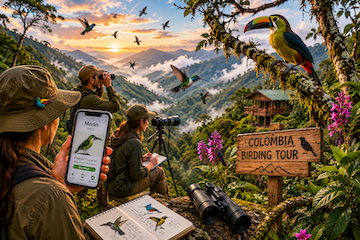
Birdwatchers use digital identification tools to learn about Colombia’s exceptional bird diversity.
Can Tulum, Mexico Get Its Groove Back?
Protected Amazon, Unprotected Rainforest
An Archaeological Journey Through the Ancient Maya Citadel of Tikal
|
HEMISPHERE ------------------------------------------1024[TRAVEL+NATURE] | |||
The Birds You Can Find With Your PhoneHow Technology Is Changing Birdwatching in ColombiaBy Marbel Montoya for Ruta Pantera on 10/18/2026 7:52:13 AM |
||||
| Birdwatching in Colombia is increasingly supported by tools that fit in a pocket. Smartphone apps can suggest the identity of a bird by its call, display photographs and recordings for comparison, and help travelers locate places where other observers have documented particular species. These tools do not replace field guides, binoculars, or experienced local guides. They do, however, make bird identification and trip planning more accessible to newcomers while creating new ways to document the country’s extraordinary avian diversity.
Colombia has recorded nearly 2,000 bird species, according to biodiversity data compiled by the Alexander von Humboldt Biological Resources Research Institute. Its geography helps explain that richness: the Andes divide into three mountain ranges, while the country also encompasses Amazonian rainforest, Pacific lowlands, Caribbean dry forests, wetlands, páramos, and the open grasslands of the Llanos. Each environment supports different bird communities, and changes in elevation can produce striking differences in the species found within relatively short distances. For travelers, that diversity creates both an opportunity and a challenge. Finding a particular bird may require knowing its habitat, recognizing its call, understanding its seasonal movements, and reaching the right location at the right time. Digital tools can help organize that information, but their usefulness depends on how carefully the results are interpreted. Merlin Bird ID: Identifying Birds by Sound Developed by the Cornell Lab of Ornithology, Merlin Bird ID helps users identify birds through photographs, descriptions, and sound recordings. Its Sound ID feature analyzes birdsong and displays possible matches while the recording is in progress. This can be particularly useful in Colombia’s forests, where birds may call from dense vegetation without ever appearing clearly in view. The technology relies on machine learning trained with bird recordings. Different vocalizations produce recognizable patterns in a sound spectrogram, allowing the system to compare what a phone captures with sounds associated with known species. Merlin can operate offline for sound identification, although users should prepare their destination information and download regional bird packs in advance if they want access to species photographs and details without an internet connection. There are important limitations. Merlin does not recognize every bird species or every vocalization, and similar calls, background noise, distance, and recording quality can affect its suggestions. A result should be treated as a candidate identification, not definitive proof. Comparing the suggested call with reference recordings and checking habitat, geographic range, and visible field marks can help confirm whether the match is plausible. For beginners, this process can turn an unfamiliar sound into a learning opportunity. Instead of simply recording a bird and moving on, observers can compare calls, notice differences between species, and gradually develop their own listening skills. eBird: Turning Sightings Into a Planning Tool While Merlin focuses on identification, eBird helps observers explore bird distributions and document their own observations. Also developed by the Cornell Lab of Ornithology, the platform combines checklists submitted by birdwatchers with maps, photographs, audio recordings, and information about locations where birds have been reported. Its hotspots are shared birding locations where multiple observers can contribute records. Before visiting a destination, travelers can check which species have been reported, review recent checklists, and identify sites worth investigating. These records can help shape an itinerary across very different environments, from Andean cloud forests and the Sierra Nevada de Santa Marta to the Amazon around Leticia, the Pacific region, and the open landscapes of Meta. A hotspot, however, is not a guarantee of a sighting. A bird recorded last week may no longer be present, and a species may be difficult to find even in suitable habitat. Observation frequency also reflects where people go birdwatching and how much effort they invest. Less frequently visited places may have fewer records simply because fewer observers have submitted checklists. The platform is valuable for another reason: observations can contribute to scientific knowledge. When birders submit complete, accurate checklists, they help build a record of where species occur and how those patterns change over time. Researchers can use these data to investigate distribution, migration, and other ecological questions, while recognizing the need to account for differences in observation effort and data quality. |
||||
|
From Digital Maps to Local Birding Experiences
Technology can help travelers discover places to observe birds, but reaching those places and understanding their ecology often depends on local expertise. In many rural destinations, guides know the calls, habitats, and daily activity patterns of birds through years of experience. They can help visitors distinguish similar species, move through sensitive habitats responsibly, and understand the wider landscape rather than treating a sighting as a checklist item. This creates opportunities for community-based tourism. Local guides, small lodges, transport providers, cooks, and reserve managers may all benefit when visitors stay longer and seek specialized nature experiences. In some locations, private reserves and rural properties have developed bird-friendly gardens with native plants and trees that provide food or shelter. Such initiatives vary by destination, but they can complement the protection of natural habitat when designed and managed appropriately. Birdwatching differs from high-volume tourism in ways that can favor smaller operators: groups may be small, visitors often travel with specialized interests, and the quality of the experience depends on the condition of the surrounding environment. Yet tourism alone does not guarantee conservation. Benefits depend on responsible management, fair opportunities for local people, and protection of the habitats that sustain the birds. Colombia’s birding destinations also have distinct histories and practical conditions. Some rural areas have expanded their nature-tourism offerings as access and local initiatives have evolved, while others remain difficult to reach or lack visitor infrastructure. Travelers should consult local operators and current guidance before planning visits to remote areas; a digital hotspot map cannot assess road conditions, access permissions, safety, or the availability of a qualified guide. Using Technology Without Losing the Field Skills The most effective approach is to treat apps as field assistants rather than substitutes for observation. Before leaving, travelers can download regional information, save relevant maps, and check recent records on eBird. In the field, they can use Merlin to investigate unfamiliar calls, then compare the result with the bird’s habitat, behavior, and visible features. Afterward, they can submit accurate checklists and recordings where appropriate. Good practice matters. Observers should avoid playing bird calls repeatedly to attract a response, particularly near nests or during breeding periods. They should also respect access rules, private property, and local guidance, and avoid publicizing the precise locations of sensitive species when disclosure could put them at risk. The relationship between technology and conservation is therefore more complex than simply identifying more birds. Digital tools can help travelers discover Colombia’s avian diversity, improve their identification skills, and contribute observations to shared databases. Their greatest value emerges when reliable records are combined with careful fieldwork and the knowledge of people who understand the landscape. A phone may help identify a song hidden in the canopy or point toward a trail with recent sightings. But the experience still depends on looking closely, listening patiently, and recognizing that every observation belongs to a larger ecological picture. In Colombia, where almost 2,000 bird species have been recorded, technology is opening new doors to birdwatching—while the forests, wetlands, mountains, and people who make those encounters possible remain at the heart of the experience. |
||||
 Add this article to your favorites
[FOR MEMBERS ONLY]
Add this article to your favorites
[FOR MEMBERS ONLY]
Copy this link to send this article to a friend: [FOR MEMBERS ONLY] |
||||
|
|
||||
|---|---|---|---|---|
| |
|
|
|
|
×
|
||||
|
References: Alexander von Humboldt Biological Resources Research Institute. Atlas of Colombia’s Endemic Birds. https://i2d.humboldt.org.co/resource?r=atlas_aves_endemicas&request_locale=en Cornell Lab of Ornithology. Merlin Bird ID: Sound ID. https://www.merlinbirds.org/sound-id/ Cornell Lab of Ornithology. Merlin Bird Packs and Offline Use. https://support.ebird.org/en/support/solutions/articles/48000966223-merlin-bird-packs Cornell Lab of Ornithology. Explore eBird Hotspots. https://support.ebird.org/en/support/solutions/articles/48001280356 Cornell Lab of Ornithology. Find Birds with eBird. https://support.ebird.org/en/support/solutions/articles/48001255128-find-birds-with-ebird |
||||
Please leave a comment about this article: 1024 |
|
| Enter your email address: |
Your email will not be displayed. |
| Your nickname: | |
| Your comment: | |
| Was this article helpful to you? | |
|
|
|
Articles about exciting travel experiences in our hemisphere.


Cape Froward, Chile




Welcome to the World’s Largest New Year’s Celebration
For those traveling from North, Central, or South America, New Year's Eve in Rio offers a rich narrative about how a city can transform a universal holiday into a unique celebration, rooted in local traditions and open to the world.





















|
Experiences Finder
(Search our catalog of Experiences here.) |
|---|