|
Pan American Experiences
|
------- |

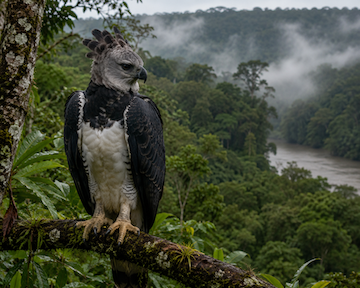
A harpy eagle watches silently above the Amazon Rainforest, where ancient trees still hold the stories, shadows, and silence of the world’s last great wilderness.
|
HEMISPHERE ------------------------------------------1021[TRAVEL+NATURE] | |||
The Harpy Eagle and the People Who Still Tell Its StoriesAn Immersive Rainforest Encounter With One of the Amazon’s Most Powerful Living SymbolsBy Marbel Montoya for Ruta Pantera on 10/8/2026 7:52:13 AM |
||||
| The first person to spot it that morning thought it was a human figure watching from the tree. The movement appeared high above the river, where mist still clung to the giant ceibas rising over the canopy. One of the guides immediately raised his hand, and the boat drifted silently against the slow current. For a few seconds, nobody spoke. Between the thick branches of the upper canopy, a gray silhouette remained perfectly still — so enormous it seemed impossible for it to belong to a bird. Then it turned its head. Yellow eyes scanned the forest with an ancient calm. The feathers on its crown lifted slightly in the humid morning wind. Beneath it, tangled roots and vines stretched across the Amazon, and the rainforest itself suddenly felt smaller. The harpy eagle had been watching us first. In many parts of the Amazon Rainforest, the harpy eagle is not simply a rare animal. It exists somewhere between wildlife and legend. Some Indigenous communities describe it as a guardian of the upper forest, a creature capable of hearing movements invisible to everyone else. Among certain Emberá and Waorani communities, stories still portray the harpy as a messenger or protector of sacred places deep in the jungle. People do not speak about it casually. Even those who have never seen one know exactly how its wings sound cutting through the air. They Say the Forest Changes When It Appears And it does. While the eagle remained perched above the ceiba tree, the howler monkeys that had filled the morning with their calls moments earlier had fallen silent. Lower in the canopy, a troop of capuchin monkeys moved nervously between branches, searching for cover. The harpy reorganized the entire forest without needing a single aggressive movement. From below, it seemed impossible that something so large could fly. Females can reach wingspans of more than two meters and weigh more than many other raptors in the Americas. Their legs are thick as human wrists, and their talons are powerful enough to seize sloths and monkeys directly from the canopy. But what truly unsettles people is not the size. It is the feeling of absolute precision. Every movement appears calculated before it even happens. A Disappearing Ruler of the Canopy One of the men in the boat, born in a nearby river community, pointed toward the ceiba and gave a small smile. “There used to be more,” he said. He did not say it dramatically. Only with the quiet exhaustion of someone accustomed to watching things disappear slowly. For generations, the harpy eagle depended on enormous old-growth trees capable of holding nests used for years at a time. Many pairs return to the same nesting tree for decades. But across large areas of Latin America, those trees are gone. Roads arrived first. Then logging. Then fires and open land where continuous forest once stood. The problem for the harpy is not only losing forest. It is losing height. |
||||
|
The species depends on ancient rainforest with towering emergent trees rising above the canopy. Once the forest fragments, the eagle disappears long before people notice its absence. And when a predator like the harpy vanishes, the behavior of everything living beneath it changes too. The forest loses one of its silent voices. Stories That Keep the Eagle Alive Still, there are places where harpy eagles continue raising chicks high above the jungle in trees too massive to wrap human arms around. Scientists, Indigenous trackers, and local communities now work together to locate nests and protect breeding territories. In some Amazonian villages, children learn to recognize the bird not only through photographs, but through stories told by grandparents beside fires or during long journeys along the river. Because some animals survive inside memory as much as they survive inside forests. At last, the harpy eagle opened its wings. The sound was deep and heavy, like a massive sheet being shaken above our heads. It descended from the ceiba with slow power before disappearing into layers of mist and wet branches. For a few seconds, fragments of gray feathers still moved through the green. Then nothing. Only the river continuing beneath the forest. Even after it vanished, nobody in the boat spoke immediately. It felt difficult to interrupt the silence after witnessing something that seemed to belong more to the ancient age of the rainforest than to the modern world. The Forest Still Remembers In some parts of Latin America, there are still people who tell stories about the harpy eagle. And as long as those stories continue traveling from one generation to the next, perhaps the forest will still remember how to keep it in the sky. |
||||
 Add this article to your favorites
[FOR MEMBERS ONLY]
Add this article to your favorites
[FOR MEMBERS ONLY]
Copy this link to send this article to a friend: [FOR MEMBERS ONLY] |
||||

|
|
||||
|---|---|---|---|---|
| |
|
|
|
|
×
|
||||
Please leave a comment about this article: 1021 |
|
| Enter your email address: |
Your email will not be displayed. |
| Your nickname: | |
| Your comment: | |
| Was this article helpful to you? | |
|
|
|
Articles about exciting travel experiences in our hemisphere.


Cape Froward, Chile




Welcome to the World’s Largest New Year’s Celebration
For those traveling from North, Central, or South America, New Year's Eve in Rio offers a rich narrative about how a city can transform a universal holiday into a unique celebration, rooted in local traditions and open to the world.




















|
Experiences Finder
(Search our catalog of Experiences here.) |
|---|